" " Words and Images: Photography

Pages

1 2 3 4 5
Showing posts with label Photography. Show all posts

Science is worship


Science is worship because it is, 
first and foremost, 
the steady observation 
of what God has put into motion
 through nature; - His creation, 
dreamed and spoken into being.
Read More

Constantia River

A river runs through a garden in Constantia after heavy winter rains

The Cape Town winter brings with it the rains, turning gardens into river beds. This river runs through a garden in Constantia off Spaanschemacht Road. The trees, plucked off all leaves by the greedy fingers of winter, cut a forlorn figure against the dull sky.
Read More

Spring is here

Lilly's in a field in Durbanville

After the winter rains the brown grass of summer turns green and lilies blossom wherever they are able to. And as spring approaches the whole of Cape Town is turned into one massive garden of green grass, lilies and fynbos.
Read More

Just outside Robertson

Scene outside Robertson shot in panoramic mode using an iPhone 5

I went for an interview for a job in Robertson and so we took a drive out there to spy out the land. It is a very small town, the closest movie house is in Worcester. On the way home, Cindy and I took a little detour into the farmlands just outside of the town and drove past this scene.. Look closely and you can see a rainbow over the little koppie.


Read More

Hout Bay Harbour

Panoramic photo taken with an iPhone5 of the Hout Bay Harbour

We took a friend of ours down to the Hout Bay Harbour for their famous fish and chips. The weather brooded over the water ominously and although it was freezing cold, it was a pleasant day to be out, especially with the thought that winter was on her way north and spring just around the corner.
Read More

Durbanville farmland

Durbanville farmland using iPhone5 panoramic function

Cindy and I found this beautiful place just outside of Durbanville on our way back from church. It was great just to get out of the car and let ourselves be surrounded by the myriad sights, sounds, creatures and fragrances of nature.
Read More

The Waterfront

The Waterfront in Cape Town shot with an iPhone 5 using its panoramic feature

Summer is on the way here in Cape Town and the Waterfront is set to getting busy. I can do without the busyness but the summer I am looking forward to.
Read More

Afternoon at the Waterfront


Panoramic photo taken with iPhone 5. The beautiful Table Mountain in Cape Town is clocked in a blanket of white clouds
Read More

Waterfront in the morning


Dark and moody, Cape Town skies brood over the Waterfront early in the morning.
Read More

Reduction

Some moments reduce
the world and all her colours
to winter black-white
Read More

Leonie E Brown Re-invented


 Shortly after winning the prestigious Absa Atelier Award, Leonie E Brown disappeared from the art world. Now, after many years, she returns with a trademark touch of magic. 


I won the National Volkskas Atelier Award for Fine Art in 1985. My university didn’t want me to enter, but John Botha, my Art History lecturer and Natascha Pretorius, a friend, believed in me when no one else did. They submitted two of my pieces. Both were accepted, and the one piece won,” the artist recounts.


But the rosy glow of the young artist’s unexpected victory was not to last. “The year after I won the Atelier Award was terrible,” says Brown. “I was filled with pain, loneliness and sadness. My work then was very harsh, angular and angry. I used a lot of cold colours and hard surfaces. Most of my work was done on hardboard.” 


The work Brown produced during this period allows the spectator to share in the emotional turmoil she was experiencing. “I employed texture to shock and repel, and a palette knife to scratch and unsettle the viewer. I recreated my misery in my work. It’s painful looking at yourself in a mirror during cold seasons. So I quit.”  

Her sojourn away from canvases lasted 14 years, leading her to many places she might never have visited had she continued as a solo artist. Some of these experiences include teaching art to high school students in Lichtenberg, working as a graphic designer in Cape Town, and living in what was then still known as Czechoslovakia. 


“Life was tough, but I was learning what varsity couldn’t teach me; who I am. All those different things I did taught me some invaluable lessons. Working as a graphic designer, for example, taught me how to work with finer details.” 


In 2000, the year before Brown got married, she found herself standing in front of a canvas once again. And when the work of art was completed, she stood back, startled by her creation. 
“It was as though I’d been reinvented. I realised that somewhere along the line, I had found inner peace. I wanted to share that with the world, but in a way that also allowed the viewer to see his own soul through my work. At first I was cautious, just brushing up on old skills,” she explains. But as her confidence rose, she began experimenting. “I believe good art is produced by artists who continually develop their technique, style and change their subject choice.” 


Not one to employ radical new media, Brown refers to herself as a traditionalist. “I won’t cut holes into a canvas, splash blood onto it and then stretch a dog skin over that. I enjoy working on a canvas using oil paints to create the picture I have in mind, and experimenting with different styles, techniques and tools.” 


Today, Brown has achieved acclaim for developing a style of painting that is recognisably her own. In one of her latest landscapes, aptly titled Coming Home, a rustic farm house stands in a field of golden grass. A muddy road runs parallel to it and off into the distance where a powerful mountain range guards the horizon. A pale blue sky holds soft white clouds in its expanse. Layers and layers of colour shine through each other to create an out of focus effect similar to pointillism. But unlike pointillism, Brown has managed to create a soft lace-like finish with very few hard edges. 

“When I started painting, I used brushes. My paintings had a flat finish. So I began experimenting with impasto. I fell in love with the textures created by applying oodles of paint. People wanted to touch my work because of it, so I started using a palette knife in conjunction with the brushes and an impasto technique to enhance the effect. Later on I only used palette knives.” 


But one day she became frustrated with the effects she was achieving. “I grabbed the closest thing to me. Let’s just call it my little secret,” she adds mischievously. “I tried that on the canvas and immediately saw the potential. Now I feel comfortable and confident working with my newfound tool. I only use a palette knife 
to create hard edges.” 

And while she still employs some of her former techniques, her new methods allow for more fluidity, and can be described as more expressionistic. 

Brown is rapidly building up a following in South Africa as well as Germany, and her work can be seen in top galleries in these countries. Her art can also be viewed on her website at www.lifeart.co.za. 


Read More
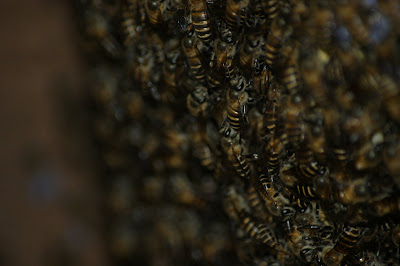
[Learning to fly: Young bees practice flying.]

Cindy and I drove into the heart of Malaysia, where we thought we would be squeezing through musty jungles; instead, what we witnessed was the mass devastation of what once
must've been a beautiful land.

Its a rugged land, none the less, way up in the sky; and we had to use 4x4's to get there. We were there to save bees that had fallen victim to progress. A 1000 hectares of virgin forest are scheduled to be
bulldozed over, burnt and
then replanted with palm oil plantations.

I'm all for progress; I love watching new buildings being built, new road systems, new cars. I love the ingenuity of man that creates a better place for all, both man and beast. But I didn't see that kind of philosophy in action here at all. All I see is a few people benefitting from a country's wealth. Poor migrant workers, mostly from Indonesia, clad in rags and living in tin shacks, were the hands used to clear the land after the bulldozers had come and gone. And when the machines had come, the animals and birds fled. Those that weren't swift enough died.

[A migrant worker walks over land once densely forested.]

We were up there with a friend, Bruce Cheong and his business partner Kenny. They are both passionate about bees and they told us many interesting stories about these little winged wonders, like; if a bee stings you, walk away from the hive first and then pull out the sting otherwise all the other bees will attack you when they smell the scent of the sting as you pull it out, and how their habitat is being destroyed(not that that needed explanation, we saw for ourselves what was being done to the forest).

While we were standing in the ruins, they pointed to the last standing hill of virgin forest in the entire area, a road from the left and road from the right, along which the bulldozers will travel, snaking towards it. Kenny told us that a tiger had taken refuge there, with all the other animals; and that a hunter would soon be sent in to shoot it, regardless of the fact that its an endangered species. The workers are scared of it and wont work with it around, so die it must!

The fate of the forest bees is the same as that of the tiger. When the loggers come across a bee hive, they chop the tree down and then burn the section of stump housing the colony, whether the bees sting or not.

Pic below: Kenny, in the white, and his friend move a
tree stump, the home of a bee colony, from the ruins
left of the forest. A piece of paper is plugged into the
entrance of the hive to keep the bee's in.

So Kenny, Bruce and Cathy have decided to put a stop to this. Not just for the sake of the bees but also for humanity. According to them, if the bees, who are the main pollinators of our vegetable and fruit crops, die out, our food sources will be greatly affected, to the point of gross food shortages.

So, they pay the loggers to call them when they come across a bee hive and then Kenny goes in with a team to remove it. If the bees are of the honey producing type, then he takes the hive back to one of his pieces of land where they are integrated into his apiary; if not, he releases them back into the wild or gives them to farmers to pollinate their crops with.

Kenny has been involved with bees for a long time. He says that he has been stung so many times now that if a bee stings him, it feels like a mosquito bite(Hence no protective clothing worn in the pic above). He fell in love with the little creatures when he decided to keep a hive as a hobby.

At that stage he was still staying in town, working as a lumber jack; but his bees, returning from forages into the neighbourhood, were stinging passerby's in their cars. And to
placate the angry drivers he would give them a bottle of the honey he had harvested from his bees. Soon however, a steady stream of cars arriving at his front gate, angry people demanding honey, he realized it was time to find a place on the outskirts of the town. Not long after that, his bee population exploded and he was able to swop careers, from being a lumber jack to being an apiarist(beekeeper!). His marketing skills were found wanting and so he approached Bruce and his wife Cathy, who were selling bee products, to help him.

Picture left: A tree stump housing a bee colony that Kenny rescued and relocated to his star fruit farm where he keeps many hives. The tree stump is propped up against a star fruit tree; and then, using a method he invented over many years, he positions a box above the old entrance of the hive. In this way, the bees are fooled into believing that their hive is now in the box itself and they start building there. Kenny is then able to open the box and harvest the honey without ruining the hive as other people would.

We managed to rescue five such logs housing hives the day that we were there. All of them were taken back to this star fruit farm. Kenny, Bruce and Cathy, however, are worried about the future of their bees here too. Masses of adjoining land, once pristine forest, have recently been cleared for rice paddies and they are worried about the pesticides the farmers will use. Bees are extremely sensitive to these poisons and multitudes of whole colonies have been wiped out as a result. So they are currently looking for ways to involve indigenous forest dwellers in protected reserves to help them care for the bees.

After we had spent the day collecting and relocating the hives, we drove to a few other locations where they keep their bees. They have involved the help of the local community, who hang hives in trees on their property, in return for some of the honey harvested. If they did not do that, other bee keepers steal their hives.

To end the day off, we got to stick our fingers into the hive, with stinging bees swarming around(Don't worry mom and dad, Kenny the expert showed us how to do it), and taste the honey. Delectable is the only word for it. The honey from each hive tasted totally different from the other. Some were sweet, some bitter, some bitter sweet, some tasted like Eucalyptus. Bruce explained that a colony will harvest the pollen and nectar from one type of flower and impregnate the honey with that particular flavour, hence the differences in taste.

Well, whatever they do and whatever flowers they pollinate, one thing is for sure, I don't know what they sell in the shops as pure honey, but its not the same thing.

Read More

A BEE'S SPITTOON

Below: A Bee's spittoon!

Below: Digging in!


Left: Bee in the box!
Read More

Flower Girl


We live in a world both
ordered and chaotic.
We live in a world full
of surprises!

Read More

Light the way

This photo, of two groups of school children with their teachers standing beneath a massive tree, was taken in the Singapore National Gardens earlier this year. I'm doing volunteer teaching work at a school in Johor Bahru, Malaysia, and it has given rise to much thought about being a teacher. And as I'm still trying to process this new experience for myself, I'll stop this post here with an invitation to anyone to leave a comment about this profession, whether student or teacher, past, present or old.
Read More

Perspective


Life is the same,
for old man and young alike.
Yet how different!

Read More

Eden


"The heavens pour forth their speech and declare Your glory!" That was the thought I had running round the mill of my mind as Cindy and I walked around the National Botanical Garden of Singapore. It was another infernally hot day, but our efforts were well rewarded with a wealth of beauty. Like with these orchids!


And these.

As expected, the gardens were impecable! The trees were shaped and trimmed, the grass perfectly manicured and the facility well thought out. A waterfall, swan lake (resplendent with swans), rain forest and lily roofed entertainment stage are all part of the gardens attractions. I loved the trees, massive trunks that shoot stories up into the blue, held there by a spreading net of roots seen and unseen, with branches of leaves fanned by the heat.

Trees, there's just something about them which remind me of God's munificence: His creativity and intelligence, beauty, fruitfulness and permanence. The photos posted this entry Cindy and I took with our dinky digital camera and the images of trees are on the roll of film I need to develop (At R80 a pop we really need to get a better digital camera as soon as possible!). So until then, here's another photo of, you guessed it, an orchid.

Read More

Summer salsa

Skin a fresh mango and peel a buttery-soft sweet melon. Resist the temptation to eat the fruit and cut into blocks a cm big. Split a lime in half and squeeze them till the last drop has fallen over the expecting flesh. Chop 3 table spoons of pine forest green coriander up and add to spice. Two teaspoons of white wine vinegar, a pinch of salt and a pinch of pepper all sweetened by a teaspoon of castor sugar and your mouth watering salsa is almost ready. And for the heavenly touch, add three small green chilies, seeded, for those with sensitive palettes, or not, for those who like it hot.
Read More

Slumdog Millionaire


"Hulle skiet an advert!" I heard one of the little guys who had just walked past say. I was intent on  getting the shutter speed and aperture settings just right. If I had had the time,  I might've turned around and explained that it wasn't for advertising's sake that I was photographing Andrew but rather for the inclusion in his salsa recipe book.

The scene reminded me of Slumdog
Millionaire; and specifically the scene where the famous movie star comes to town in his
helicopter; and landing is swamped by adoring fans. Now, we are by no means stars, nor
were we being swamped by a mass of adoring fans, not even by one googled eyed being of
any sort for that matter, but the surroundings somehow seemed similar. The likeness was
in this - it doesn't matter where you are in the world, poverty always wears that same
acrid mask.

I put the thought aside, I had a job at hand; and who knew, perhaps one of those kids, or
more likely their parents, would want to buy our finished product. In Slumdog
Millionaire, the lead actor does everything in his power to be with his childhood
sweetheart, so why wouldn't a poor epicurean pay for a beautiful book crammed with
delicious salsa's of every sort?

So I did my job as best as I could and the end result is a selection of really great shots
of Andrew which epitomize what we are trying to achieve with this recipe book:
attractive and tasty food, easily made and for all occasions.

What hasn't been as easy as making Andrew's salsa's though, is taking photos of them.
Three things I've realized can make a world of difference when taking photos of food are;
1. With property its location, location, location but with food shots its setting, setting,
setting! It influences lighting, ambience, background and can give one space to work in
or totally restrict the variety of shots one is able to take. So do your best to get the best
setting for your shoot! It's worth the effort.
2. Having a food stylist to co-ordinate and organize the decor for the shoot and then
to help on the day with the setting up of the table and to make sure that the food
looks photo sharp all the time(Its amazing how quickly a sprig of whatever can wilt).
3. Equipment, the better the better and the more the better. Things almost never go
according to plan and so its safe to say be prepared for all types of situations, like too
much light, too little light, no electricity etc etc.

But at the end of the day, we can't always have the best all the time, especially if just
starting out, and if that's the case, then be prepared to just slumdog it and use what you
have!

Read More

Believe

Flowers, of diverse colours
spring up around the dusty fall
of each step, perfumes the air
anointing me and passerb y's
this is the reward of those who seek God
and believe that He is and wants to bless
what a mighty God, who can resist Him?
He makes a way in the desert
edged by flowers, pools of crystal waters
rivers of life, green grass and glades of shade
without ending, that can never be stopped
Be exalted Jesus, be exalted!
Read More
 
Words and Images | by WITTSTOCKMEDIA ©2012